tag:politicalscience.nd.edu,2005:/news-and-events/newstag:politicalscience.nd.edu,2005:/latestDepartment of Political Science | News2026-10-08T10:57:00-04:00Notre Dame's Political Science: Award-winning faculty, diverse perspectives, & excellent teaching. Explore undergraduate & graduate programs.tag:politicalscience.nd.edu,2005:News/1861062026-10-08T10:57:00-04:002026-10-08T10:57:41-04:00Alumni Association and YoungND Honor 2026 Domer Dozen
The Notre Dame Alumni Association announced its 2026 Domer Dozen cohort, honoring 12 graduates ages 32 and younger for excellence in their contributions in learning, service, faith, and work—the core pillars of the association’s mission.
The Domer Dozen program is the signature initiative of YoungND, the Alumni Association’s young alumni group. The 2026 honorees have excelled in medicine, public and military service, scholarship, the arts, advocacy, and religious life, among other areas.
“Each of the 2026 Domer Dozen honorees has taken a different path since graduating from Notre Dame, but all have found ways to weave the mission of Our Lady’s University into their everyday lives,” said Dolly Duffy ’84, executive director of the Alumni Association. “Through their work, the communities they serve, and the way they show up for the people around them, these incredible young people are living examples of what it looks like to build lives of purpose and meaning.”
The 2026 Domer Dozen honorees are:
Dr. Erik Carlson ’16 — Accompanying seriously ill patients through the most difficult moments of their lives
Richard Clark, Ph.D., ’16 — Driving scholarship on globalization, international finance, and climate change in global institutions
Jennifer Flanagan ’18 — Creating encounters between people who would otherwise never meet
Shannon Gaylord ’17 — Bringing lived experience to a disorder few providers are trained to treat
Andrew Halt ’17 — Bringing technical rigor and creative strategies to civic problem-solving
Adam Henderson ’16 — Litigating for veterans in an area of the law he has long been passionate about
Liz Hynes ’17 — Writing comedy in New York and standing with the writers who make it
Madelyn G. Kennedy ’17 — Offering a soft landing for families in need
Dr. Beverly Kyalwazi ’17 — Expanding equitable access to liver transplantation and care
Brandon Ruggles ’17 — A people-first leader building strong teams and developing future leaders
Rev. Brian Vetter, C.S.C., ’17, ’23 M.Div., ’25 M.Ed. — Building relationships with young people in the classroom and helping them know the love of Christ
Lt. Thomas Yaeger Jr. ’18 — Committing to service that extends well beyond a career in uniform
Originally published by Joanne Norell at news.nd.edu on October 08, 2026.
]]>
Joanne Norelltag:politicalscience.nd.edu,2005:News/1859442026-10-02T12:17:00-04:002026-10-02T12:17:13-04:00Dave Campbell has been selected to join the NAEP Civics Development Panel by the National Assessment Governing Board
"After putting out a nationwide call for leaders with expertise in civics, the National Assessment Governing Board has assembled three groups, charged with supporting updates to the NAEP Civics Framework. Frameworks describe the knowledge and skills assessed by the National Assessment of Educational Progress (NAEP).
The NAEP Civics Framework Development Panel is charged with centering civics content knowledge, drawing from primary and authentic sources, and representing the application of civics knowledge in a nonpartisan manner. They work to reach consensus and provide a draft framework for the Governing Board’s consideration. Meet the panelists."
Originally published by Rooney Democracy Institute at rooneyinstitute.nd.edu on October 02, 2026.
]]>
Rooney Democracy Institutetag:politicalscience.nd.edu,2005:News/1859132026-10-01T08:14:00-04:002026-10-01T08:14:03-04:00Political scientist wins Robert A. Dahl Award for book on how incumbency influences electionsLuis Schiumerini lectures to students in the class World Politics: An Introduction to Comparative Politics. (Photo by Jon L. Hendricks/University of Notre Dame)
As a political scientist, Luis Schiumerini has made it his job to find what makes democracy tick — what forces influence electoral outcomes, what incentivizes politicians, and how citizens make their government work. And it goes beyond a strong scholarly curiosity — he wants to learn how to make democracy better.
It’s the goal he had in mind when he wrote Incumbency Bias: Why Political Office is a Blessing and a Curse in Latin America (Cambridge University Press, 2025), which recently won the 2026 Robert A. Dahl Award from the American Political Science Association. The recognition marks his monograph as one of the best books written on democracy.
Established in honor of political theorist Robert A. Dahl, the award is presented to an untenured scholar who has produced high quality work on the subject. Schiumerini did not have tenure when he published Incumbency Bias, but he has since become an associate professor in the Department of Political Science at the University of Notre Dame.
Luis Schiumerini
“The award is named for one of my heroes,” Schiumerini said. “When I teach what democracy means at Notre Dame, I assign Robert Dahl’s classic Polyarchy, so I’m very honored.”
Comparing electoral trends in Brazil, Chile, and Schiumerini’s home country of Argentina, Incumbency Bias examines how holding office impacts a politician’s chances of getting reelected.
“Above all else, regardless of whether you’re ideologically a good fit or competent or honest, just holding office itself changes your electoral fortunes,” Schiumerini said.
But whether incumbency is a positive or negative bias varies across countries and offices. In the United States and Argentina, incumbency is usually an advantage, but in Brazil, incumbents are less likely to be reelected. And according to Schiumerini’s research, this isn’t random.
“My book says this is actually the natural result of democratic elections working pretty much as we expect them to work,” Schiumerini said.
When voters cast their ballots, they assess the work of their leaders and representatives. Did they deliver public goods? Did they generate economic growth? Did they reduce unemployment? When the answers to these questions guide the polls, voters hold politicians accountable for their actions based on their performance, Schiumerini said.
But sometimes, politicians are held accountable for things they can’t really control. For example, Brazilian mayors have many responsibilities, including health, education, and transportation — a high policy scope. But because of how money is distributed in the Brazilian government, Schiumerini said, mayors often don’t have the resources to carry out their responsibilities — low incumbent capacity.
On the other hand, Argentinian mayors have many more resources and the discretion to use them. Also, unlike Brazilian mayors, they can incur as much debt as they deem necessary to carry out their duties. This higher incumbent capacity gives them a significant incumbency advantage.
“The mismatch between incumbent capacity and policy scope is what shapes the degree to which incumbents meet expectations across the world,” Schiumerini said.
Incumbency Bias contends that differences in incumbency bias result from differences in the alignment between citizen expectations and incumbency capacity . It’s the first book written on the subject at all, let alone in Latin America, and uses cutting-edge techniques to pin down causal effects.
“Building knowledge on politics can also inform citizens across the most important industries in society — economics, religion, education, culture. That’s why the research of political scientists matters.”
The book also comes at a time when incumbency is top of mind for political scientists, as the world has recently experienced and an anti-incumbency wave in national elections. Until Argentina’s last two presidential elections, no sitting president had ever failed to be reelected in the country. While Incumbency Bias focuses on subnational rather than presidential elections, the book’s theory could aid future research on the recent “incumbency curse” in national politics, Schiumerini said.
But what really makes the book special is how it puts a niche issue into the broader context of democracy’s global health.
“The book is ultimately asking, ‘Is this good for democracy?’” Schiumerini said. “It encourages scholars to think more about the institutional design of democracy, particularly how responsibilities are allocated across offices in relation to the capacity of those offices.”
Incumbency Bias reveals that even if elections are free and fair — no tally meddling, no voter intimidation, no media control — the results can be biased simply because of institutional discrepancies between politicians’ responsibilities and capabilities. And because democracy affects everyone, it’s something everyone should be learning and talking about, Schiumerini said.
“Building knowledge on politics can also inform citizens across the most important industries in society — economics, religion, education, culture,” he said. “That’s why the research of political scientists matters.”
Originally published by Adah McMillan at al.nd.edu on October 01, 2026.
]]>
Adah McMillantag:politicalscience.nd.edu,2005:News/1859122026-10-01T08:13:00-04:002026-10-01T08:13:38-04:00Justice Brett Kavanaugh and other distinguished guests remember 9/11 at 2026 Jeanie Poole O’Shaughnessy Memorial LectureAngela Moreno ’27 and Will Carlson ’27 open the "25 Years After 9/11" conversation.
A quarter century after the terrorist attacks of September 11, 2001, a panel of distinguished guests related their harrowing firsthand experiences of the tragic day and its aftermath at the Center for Citizenship & Constitutional Government's 2026 Jeanie Poole O’Shaughnessy Memorial Lecture.
The panel consisted of United States Supreme Court Associate Justice Brett Kavanaugh; president emeritus of the University of Notre Dame Rev. Edward A. “Monk” Malloy, C.S.C.; former March for Life president Jennie Bradley Lichter '04; and Piper Sandler vice chairman and senior managing principal James J. “Jimmy” Dunne.
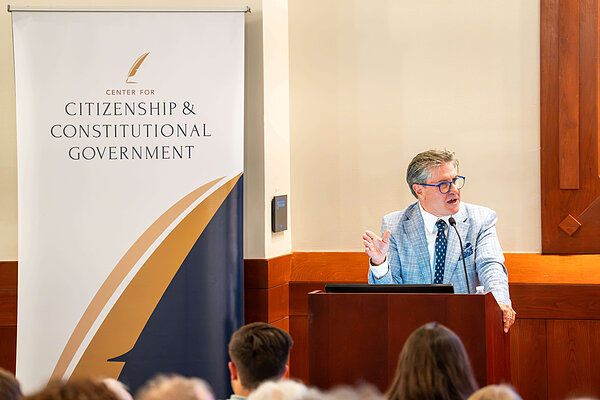
University of Notre Dame President Rev. Bob Dowd, C.S.C. opened the program by recalling his own experience as a graduate teaching assistant and leading a prayer of remembrance. Tocqueville Fellow Will Carlson '27 then led the Pledge of Allegiance, and Tocqueville Fellow and CCCG intern Angela Moreno '27 introduced the members of the panel. Then, with CCCG founder and director Professor Vincent Phillip Muñoz facilitating, the panelists ensured that the audience in the DeBartolo Performing Arts Center would not forget the sobering day.
The speakers’ proximity to September 11’s events ranged from New York to the White House to Notre Dame’s campus, offering a breadth of insights. Joe Manning ‘28, a sophomore majoring in history, noted that “it was very thought-provoking to hear the stories of the day from a former Notre Dame student all the way up to a Supreme Court Justice.” The panel’s cumulative experiences demonstrated the intertwined stories of 9/11 and the University of Notre Dame.
Jimmy Dunne ‘78, who currently serves on the University’s Board of Trustees, was a senior managing principal at Sandler O’Neill + Partners, which was located in the South Tower at the time. Dunne was out of the office on the morning of September 11 playing golf when he heard the news. “I buckled, and I hit the ground,” Dunne recounted, becoming emotional.
At the time of the attacks, the now-Justice Kavanaugh worked in the White House as an Associate Counsel to the President. He described how “the Secret Service came down to the basement and said ‘You gotta run, you gotta sprint.’” When asked where the staff was supposed to evacuate, the Justice responded, “We didn’t have anywhere to go.” His narrative underscored the chaos and fear experienced in Washington that day.
Jennie Bradley Lichter '04 speaking at the DeBartolo Performing Arts Center.
Jennie Bradley Lichter was an undergraduate student at the time and experienced the events from her dorm room in Lyons Hall. “It didn’t make any sense,” she remembered thinking while trying to process the news. Morning classes were dismissed, so she recalled “spen[ding] the rest of the morning watching TV and being together, which was all we really could do.”
Fr. Malloy, as president of the university, had to react with composure to prevent panic and ensure the safety of students and staff. He recalled telling his staff that “[the] first thing we’re gonna do is worry about the students and their families.” He canceled classes for the rest of the day and quickly organized a Mass to be held on South Quad. “We walked out, and it was utter silence,” Malloy recounted. In his homily, he invoked Matthew 11:28: “Come to me, all who labor and are heavy laden, and I will give you rest.” Rather than holding hands for the Our Father, the congregants locked arms, a testament to the supportive nature of the campus community in an uncertain time.
Each panelist emphasized how inconceivable September 11 truly was, helping the undergraduates in the audience, born after 2001, better appreciate the significance of the event. Lichter’s framing of the shocking events around familiar campus experiences allowed her to serve as a “way-back time machine for the students in the audience.” Conveying the stunning nature of the day, Justice Kavanaugh recalled thinking at the time “this doesn’t happen in America.” Dunne, directly addressing the students, explained that while “terrorism is now in our psyche, it was not then.” The events permanently altered Americans’ frame of mind.
The panelists' evocative stories effectively communicated the emotional weight of 9/11 to students in the audience. Tocqueville Fellow Thomas Mitchell ‘27 reflected after the talk that “one thing that Jimmy [Dunne] did really well was help us have the same feeling, and understand deep down what it felt like to be an observer [of 9/11].”
While the panelists shared their grief and sorrow, they also offered optimistic insights. Justice Kavanaugh's message for the students was that “we have much more in common as Americans” than today's divisions suggest. While the polarization of today has become normal for most students, it is important to remember a time of national unity.
Archival photographs and newspaper clippings on display during the 2026 Jeanie Poole O’Shaughnessy Memorial Lecture.
Dunne emphasized that even the most accomplished people cannot be isolated from adversity. “These are the greatest minds that we have,” he said, referring to his fellow panelists, adding that still, “it was utter chaos.” Nonetheless, the panelists, as well as the country, persisted. He credited his upbringing and Notre Dame education for his own resilience in the aftermath of the crisis.
“The thing I would want young people to understand is that you’re going to have serious and significant challenges,” Dunne advised. “Bad things are going to happen, so you want to get yourself where you're preparing early for that.” Dunne’s counsel of preparation for adversity resonated with students. Tocqueville Fellow Jack Rankin ‘28 said that the stories made it “the most inspiring panel I’ve been to at Notre Dame, especially Jimmy Dunne's contribution,” namely, his call to be prepared for adversity and be action-oriented in response.
While this year’s Jeanie Poole O’Shaughnessy Memorial Lecture had a somber tone, it highlighted the resilience of the Notre Dame community as well as the American nation during one of its darkest days.
The Jeanie Poole O’Shaughnessy Memorial Lecture was established in 2022 after the death of the Center’s beloved friend and supporter in 2021 and made possible by Patrick O’Shaughnessy and the O’Shaughnessy Family.
This endowed lecture is designed to connect scholarship and education concerning the ideas and institutions of constitutional government with the principles put into practice by the individuals shaping the civic fabric of our country.
Originally published by Jack Knorr at constudies.nd.edu on September 30, 2026.
]]>
Jack Knorrtag:politicalscience.nd.edu,2005:News/1858922026-09-30T12:16:00-04:002026-09-30T12:16:58-04:00New Article Published by Jim Curry: "Opinion: Congress is checking Trump. It’s just doing it quietly"
"Ever since President Donald Trump took the oath of office in January 2025, pundits have agreed on one thing: Congress has rolled over. Lawmakers, we’re told, have handed their powers to the president, the separation of powers is broken and Capitol Hill is to blame.
That story is wrong. Congress has pushed back on this president, repeatedly and in ways that matter. Most people just missed it because Congress has pushed back slowly, quietly or both."
Originally published by Rooney Democracy Institute at rooneyinstitute.nd.edu on September 30, 2026.
]]>
Rooney Democracy Institutetag:politicalscience.nd.edu,2005:News/1858912026-09-30T12:15:00-04:002026-09-30T12:15:51-04:00New Article Published by Matt Hall, Brittany Solomon, and Tyler Leigh: "Why ‘democratic neutrality’ is an overlooked threat to American democracy"
"In recent years, a growing number of elected officials have questionedor outright denied the results of elections, sought to underminefreedom of speech, and attempted to bend electoral rules to benefit themselves.
Only a sliver of Americans say they support these kinds of antidemocratic actions. For example, just 8% of Americans support making it harder for their political opponents to vote.
So how do politicians who espouse antidemocratic views continue to win elections if these policies are so unpopular?
As scholarsaffiliatedwith theRooney Democracy Institute at the University of Notre Dame, we analyzed surveys of over 48,000 Americans conducted by YouGov, NORC at the University of Chicago and Bovitz between September 2022 and July 2025 to try to get an answer.
A key finding emerged: A significant swath of Americans were actually indifferent toward antidemocratic practices.
This is an important distinction. Prior research tended to assume that if a person doesn’t support antidemocratic practices, then they must oppose antidemocratic practices. In other words, if only 8% of the public supports making it harder for political opponents to vote, then roughly 92% of Americans must oppose making it harder for opponents to vote.
However, our research shows that there is actually a big chunk of Americans – at times a proportion as large as 52% of voters – who neither support nor oppose antidemocratic practices. While only a small number of Americans outright support violating core democratic norms, many Americans express no opinion about politicians who undermine democracy.
We call this attitude toward antidemocratic practices “democratic neutrality,” and we believe it’s an overlooked and understudied threat to democracy."
Originally published by Rooney Democracy Institute at rooneyinstitute.nd.edu on September 30, 2026.
]]>
Rooney Democracy Institutetag:politicalscience.nd.edu,2005:News/1857942026-09-28T10:28:00-04:002026-09-28T10:28:10-04:00Five early-career scholars form second Arts & Letters cohort of prestigious Notre Dame postdoctoral fellowship program
Five interdisciplinary scholars have joined the College of Arts & Letters at the University of Notre Dame to continue their research, obtain invaluable support, and engage in professional development as part of the Provost’s Postdoctoral Fellowship Program.
Led by Katie Bugyis, the Rev. John A. O’Brien Associate Professor in the Program of Liberal Studies and the College’s director of postdoctoral studies, this year’s Arts & Letters cohort will each receive a generous stipend, research support, mentorship, and professional development opportunities. The group will contribute to research and teaching in the Institute of Latino Studies and in the departments of Anthropology, Music, Philosophy, and Political Science for the next two years.
“The five new Provost’s Postdoctoral Fellows are the very best early career scholars in their respective fields,” Bugyis said. “I spent the past spring and summer imagining myriad ways in which they would expand the disciplinary breadth of the program and enrich the lively interdisciplinary exchange among the fellows and committed faculty in participating departments and institutes, and I have been thrilled to see the realization of those hopes at our initial events. I look forward to building on the program’s great strengths in the year ahead.”
Environmental anthropologist Aida Arosoaie focuses her research on the social, ecological, and geopolitical entanglements arising from competing practices of resource extraction in Southeast Asia.
Drawing on more than two years of archival and ethnographic research, her doctoral work at the University of Wisconsin-Madison analyzed the historical connections among natural rubber cultivation, tropical forestry management, and synthetic rubber production in Southeast Asia over the last century. With a multi-methodological approach — including oral histories, archival work, ethnography, collaboration, and creative art-making — she investigated the complex dynamics between technoscience, extractive practices, racial capitalism, and postcolonial frameworks of justice.
In the Department of Anthropology, Arosoaie plans to expand her research through two new projects — the first, a monograph, examining how overlapping plantation and ecologies in Malaysia engender new modalities of negotiating power, and the second, a book, conceptualizing climate change as a synthetic affliction at the intersection of different modes of resource extraction, such as monocrop plantations and petrochemical production.
In addition to a Provost’s Postdoctoral Fellowship with Arts & Letters, Arosoaie will also be a concurrent fellow with the Just Transformations to Sustainability Initiative. There, she will examine the shifting notions of sustainability that have emerged from the management of tropical forestry over the past decades.
“I am very grateful for the opportunity to join the thriving intellectual community at the University of Notre Dame,” she said. “By supporting my postdoctoral journey, the College of Arts & Letters will enable me to simultaneously strengthen my research agenda and advance its intellectual goals,” she said.
YuHao Chen — Music
YuHao Chen is a sound studies scholar whose research traces the interplay between sound-writing technology and embodiment in East Asia during the late 19th and early 20th centuries. He received his Ph.D. in music, with graduate certificates in Asian studies and cultural studies, from the University of Pittsburgh and, most recently, was a postdoctoral fellow in the Global Arts + Humanities Society of Fellows at The Ohio State University.
In the Department of Music, Chen plans to extend his doctoral research into various publications. His first book, tentatively titled “Phonographic Conversion,” aims to expand traditional views of sound recording by looking at phonetic reading systems as musical records in the context of early Chinese disability education. His second work, tentatively titled “Archives for the Unsound,” considers the role of silence in 19th-century Western perceptions of China.
“Taken together, my research addresses the overarching question of what it means to be human in the machine age during the late 19th and early 20th centuries,” he said.
“I am eager to initiate conversations around art-based methods for the humanities,” he said.
Mattlyn Cordova — Institute for Latino Studies
Mattlyn Cordova is an American studies scholar with a focus on film and digital studies, Latinx visual culture, affect theory, and brownness. Her research examines the role of digital technology in society’s understanding of racial and ethnic formations in the United States.
A Harvard University graduate, Cordova plans to expand on her dissertation, “Brown Belongings: Intimacy and Community Making in Twenty-First Century Latinx Digital Media,” into her first book manuscript. The book will explore the relationship between the formation of Latinidad and digital spectatorship and consider how digital distribution has enabled new forms of viewing and new modes of spectatorship that facilitate the creation of communities among dispersed spectators.
“Drawing from Latinx performance studies scholarship, I argue that recent technological and media shifts invite new forms of intimacies and identities, ones that illuminate a vibrant understanding of Latinx spectatorship and community,” said Cordova, who will join the Institute for Latino Studies (ILS). “This project will consider the use of virtual reality, specifically as a medium that asks viewers to become part of the image.”
“This program appeals to me not only because of Notre Dame’s investment in the arts and humanities, as evidenced by the University-wide Arts Initiative,” Cordova said, “but also because of the vibrant community the Institute for Latino Studies offers.”
Stephen Mackereth — Philosophy
Previously a member of the Dartmouth Society of Fellows, Stephen Mackereth studies logic, philosophy of mathematics, and the history of analytic philosophy. He specifically researches the epistemological and conceptual structure of mathematics using the methods of mathematical logic.
“What is particularly delightful about this approach to the philosophy of mathematics is that it becomes possible to prove mathematical theorems that have significance for our philosophical understanding of mathematics as a whole,” Mackereth said. “These theorems belong to the tradition of metamathematics, or mathematics reflecting upon itself.”
Mackereth’s research interests stem from an effort to understand the great foundational debate in 20th-century mathematics between logicists and constructivists, as well as the effects of this debate on the subsequent development of analytic philosophy. He enjoys thinking about logical and semantic paradoxes; about the concepts of proof, truth, computation, and definition; and about the nature and significance of foundations in mathematics.
In the Department of Philosophy, Mackereth will be mentored by Joel David Hamkins, the John Cardinal O'Hara Professor of Logic. He plans to expand on topics he has written about, such as neo-Fregean logicism and Kurt Gödel’s Dialectica translation.
Oliver Silverman — Political Science
Political theorist Oliver Silverman aims to illuminate how classical political ideas emerged in explicit opposition to insurgent social-struggle practices. Silverman’s current project, “Profane Heaven: Apocalypse from Below and the Invention of Utopia,” offers a novel theory of utopia as both a political concept and a genre.
While utopian literature is commonly associated with egalitarianism and the imagination of communitarian alternatives, Silverman argues that the first English utopian works — by Thomas More, Francis Bacon, and James Harrington — were elite reactions to popular rebellions. Silverman further argues that the idea of utopia appeared as a secular version of heaven, an always-elsewhere good place, that delegitimized struggles for real equality on Earth.
“Reading classic works of political theory in the context of the popular uprisings that unfolded as they were written, I demonstrate that one of the most classic ideas in the history of political thought, utopia, is a product of both philosophical and political repressions of revolutionary movements,” Silverman said.
Silverman completed a Ph.D. at The Graduate Center, City University of New York (CUNY) and has been published in journals such as Political Theory, History of the Present, Utopian Studies, and Theory & Event. Silverman will work closely with mentor Mary Keys, professor in the Department of Political Science.
Originally published by Mary Kinney at al.nd.edu on September 28, 2026.
]]>
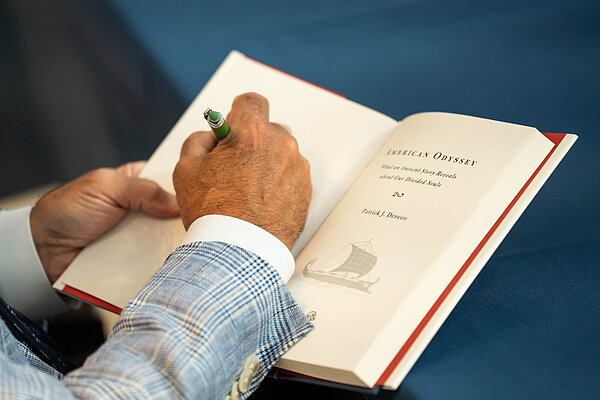
Mary Kinneytag:politicalscience.nd.edu,2005:News/1857852026-09-28T07:37:00-04:002026-09-28T07:37:15-04:00Patrick Deneen on the Odyssey, the American character, and the search for homePatrick Deneen signs a student's copy of his new book, American Odyssey.
Well-known professor of political science Patrick Deneen gave a lecture on August 27 based on his newest book, American Odyssey: What an Ancient Story Reveals about Our Divided Souls. This lecture, hosted by the Center for Citizenship and Constitutional Government (CCCG), took place in the wake of the United States of America’s semiquincentennial and the theatrical release of Christopher Nolan’s adaption of the Odyssey.
Deneen, who previously taught at Princeton University and Georgetown University, rose to national prominence following the 2018 publication of his book, Why Liberalism Failed. He is also the author of Regime Change: Towards a Postliberal Future (2023). Notably, his 1995 award-winning dissertation is also based on the Odyssey, entitled The Odyssey of Political Theory: Homer's "Odyssey" as Political Theory and as Interpreted in the History of Political Thought.
Deneen began his lecture by asking a simple question: “What do the birth of America and the ancient epic of the Odyssey have to do with each other? … I dare say, a great deal.” Like Odysseus, America’s forerunners undertook an arduous journey by sea. Odysseus traveled to find his home; our pilgrims hoped to find theirs.
Deneen delivers remarks at the Eck Visitors Center.
Referencing the Star Trek franchise, Deneen applied its most recognizable phrase to the American people, past and present: we have a “craving and desire ‘to explore strange new worlds; to seek out new life and new civilizations; to boldly go where no man has gone before.’”
He continued, “Even before we thought of ourselves as Americans, before the official birth of our nation, our forebears were embodiments of … one of the most deeply ingrained American characteristics: the desire to explore; the restless craving for more, for the distinct, for the new; the dissatisfaction of the familiar that would become the engine of our—even today—exploratory and entrepreneurial spirit.”
Dorothy Gale in The Wizard of Oz, Deneen said, exemplifies this American spirit. In Dorothy, “We encounter a version of ourselves, a young dreamer marked by that characteristic discontent … longing for that better place that lies beyond the horizons that just at this moment accidentally contain us.” And yet, by the end of the journey, her mantra is, “‘There's no place like home. There’s no place like home.’ … That will bring her home.”
Deneen used the example of George Bailey in It’s a Wonderful Life as another illustration. Bailey “desperately craves to get out of Bedford Falls,” yet “nevertheless becomes perhaps the greatest of contributors to the life of his town in a way that was unseen and unbeknownst, even to himself…” By committing to Bedford Falls and relinquishing personal ambition, he saves the whole community from ruin. During the Q&A, Deneen held Bailey out as a worthy model for students who are animated but also concerned by this American spirit. Odysseus, Deneen reminded students, was condemned by the poet Dante for his “lust to experience the far-flung world and the failings and felicities of mankind,” for which he left his family. He also recalled one of Tocqueville's observations of Americans: “Americans will build a house, and before the roof is finished, they'll sell it and look for another one.”
Mercedes Curran '27 introduces Deneen at the lecture.
Yet, George Bailey offers a solution. By setting down roots and investing in their communities, students can be like the heroic—though unglamorous—George Bailey.
Mercedes Curran, a senior Tocqueville fellow, reflected on the lecture. “For the students in the audience, Deneen offered moving remarks about discerning what their service might be to their communities, in light of the prudential lessons pulled from the Odyssey.” Though Deneen “may have left listeners with more questions than answers, it encouraged us to consider the balances and nuances of what it means to be an American.”
Connor Morrissey, a graduate student in Notre Dame’s sacred music program, said, “One of the things that I found the most fascinating about this particular lecture is the personification of the Aristotelian quote that ‘virtue is the mean between two vices.’ We have to steer in between the American Scylla and the American Charybdis, and how we might have to chart our course closer or further from one or the other depends on where we're at in our civilizational zeitgeist.”
The students who attended the event departed with a choice: Should they be a homebody or a pioneer? A trailblazer or a family man? A possible answer includes both—so long as one can avoid the worst snares of either, one may embody what it truly means to be an American.
To view the full recording of Deneen’s remarks, as well as past event archives, visit our lecture library.
Originally published by Jack Krieger at constudies.nd.edu on September 27, 2026.
]]>
Jack Kriegertag:politicalscience.nd.edu,2005:News/1857072026-09-23T11:59:00-04:002026-09-23T11:59:14-04:00For Good: Why Notre Dame still believes in the liberal arts, with Dean Kenneth Scheve
In an age of artificial intelligence, rapid change, and global uncertainty, Kenneth Scheve ’90, the I.A. O’Shaughnessy Dean of the College of Arts & Letters and Keough -Hesburgh Professor of Political Science, believes the liberal arts are not becoming less relevant — they are becoming more essential.
At Notre Dame, he’s building on the University’s tradition of educating both the heart and the mind while preparing students to think deeply, engage new ideas, and lead with purpose.
Join us for this episode of For Good as Dean Scheve reflects on the enduring role of Arts & Letters at Notre Dame, the College’s growing commitment to global education and research that serves the common good, and why a liberal arts education remains one of the best foundations for leadership and service in a changing world.
Originally published by ND Loyal at al.nd.edu on August 07, 2026.
]]>
ND Loyaltag:politicalscience.nd.edu,2005:News/1856892026-09-22T15:25:00-04:002026-09-22T15:26:02-04:00American Experiment Leadership Seminar Winning Essays
The Center for Citizenship & Constitutional Government (CCCG) is pleased to announce the winners of the American Experiement Leadership Seminar Essay Contest.
As a capstone to the CCCG's inaugural high school Leadership Seminar (entitled "The American Experiment: Liberty for All?"), each participant wrote a reflection essay. Our team recognized the following two essays, written by Alexander Wenk and Will Blake, for their thoughtful engagement with the themes of the seminar.
Alexander Wenk
The “American idea” encompasses a plethora of principles, from states’ rights to separation of powers. Yet at their core, they are all attempts to implement the two fundamental components of the American idea, both laid out in the opening lines of the Declaration of Independence. The first concerns individuals: “that all men are created equal, that they are endowed by their Creator with certain unalienable Rights, that among these are Life, Liberty, and the pursuit of Happiness.” The second principle describes the relationship of the ideal American government to the first principle: government’s purpose is to “secure these rights.” However, such a government can only exist legitimately by deriving its “just powers from the consent of the governed.” Essentially, the American idea is a nation of people equal in rights who collectively agree to support a government that protects those rights.
On the face of it, the personal and governmental components of the American idea seem easily reconcilable. After all, if all people have rights and the government protects those rights, then where lies the conflict? The tension between these two components is in the inherent tradeoff of government: in order to protect rights, it must limit people’s liberty to do as they please. It is impossible to have a government that provides complete protection for all rights while also enabling total freedom of action. Therefore, the debate over the role of government, and consequently how the American idea ought to be realized, is not a debate over whether the government ought to protect rights, but a debate over two things: which rights deserve to be recognized and prioritized, and how much the government should limit the right to liberty to protect other rights.
The debate over the prioritization of rights played out in the years leading up to the Civil War, as Americans passionately disagreed over whether the exercise of the majority’s democratic powers could limit the rights of others. The debates between Abraham Lincoln and Stephen Douglas about whether slavery should be allowed in states entering the Union illustrate the tensions between the principles laid out in the Declaration. Douglas was the most famous advocate of the affirmative position, commonly referred to as popular sovereignty. He explained his reasoning as such: “our liberty and independence are based upon the right of the people to form for themselves such a government as they may choose.” At first glance, this appears clearly aligned with the principles of the Declaration, since to be legitimate a government must be based on the consent of the people. If the people are not able to choose the kind of government they want (slave or free), then there can be no consent, and therefore no legitimate government.
However, Lincoln disputes this based upon the other principle enshrined in the declaration: that all people have certain unalienable rights, regardless of the will of others. In fact, he asserts that in allowing people the absolute ability to determine their own government, “the sacred right of self-government is grossly violated.” How is it, then, that the power to choose your government is violated precisely by choosing your own government? Because, as Lincoln states, “when the white man governs himself that is self-government; but when he governs himself, and also governs another man, that is more than self-government—that is despotism.” Lincoln’s argument against absolute self-government can be summarized as follows: when your choice violates the rights of another, you do not have the right to make that choice. Yet by denying individuals the right to choose, the government denies the sacred right of popular sovereignty, which Douglas interpreted as fundamental to the principle of the consent of the governed outlined in the Declaration. Whichever side you agree with, a clear tension within the American idea can be seen in the debates between Lincoln and Douglas: the choice of what rights the government ought to prioritize.
The other tension inherent to the American idea—the extent to which the government should limit individual liberty to protect rights—has fortunately not led to anything so dramatic as a civil war. That does not mean, however, there has not been significant conflict due to this tension. One of the clearest examples of such conflict was the 1943 Supreme Court case West Virginia State Board of Education v. Barnette. Barnette overturned the Court’s 1940 Gobitis decision, which mandated that students comply with requirements to salute the American flag, regardless of their religious beliefs. The decision in Gobitis was based on the idea that the promotion of patriotism, even by limiting religious liberty, was necessary to maintain the “free society without which religious toleration itself is unattainable.” Yet in Barnette, the Court decided the opposite, stating that “freedom to differ is not limited to things that do not matter much.” In this case, the Court prioritized religious liberty, even if that meant sacrificing some national unity and thus potentially endangering the power of the government to uphold rights. While in Gobitis, the Court held that the exercise of religious freedom could be limited in pursuit of a society that protected rights for all, in Barnette the Court decided that it could not. Together, Gobitis and Barnette make clear the second overarching conflict seen throughout the history of the American idea: in what ways and to what extent can liberty be limited to protect the rights of all?
Neither of these issues have been settled, historically or in the present day. Americans continue to debate: what right should be prioritized, a baby’s right to life or the right of a woman to make her own reproductive decisions? In pursuit of a safe academic climate, should the government limit students’ ability to protest? We may eventually reach a consensus on some of these topics: for instance, that people do not have the right to choose to enslave others. This discussion, though, reflects the system the Founders designed. The prescient ideas within the Declaration created the principled foundation for a country that could evolve towards the ideal balance of natural rights and self-government. As we continue to debate how to best achieve that balance, we grow closer to fulfilling those fundamental principles of the American idea.
Alexander Wenk is a senior at Cold Spring Harbor High School in New York. He serves as the president of Huntington Youth Court and captains his high school debate team. In his spare time, he enjoys running, reading, and spending time with friends.
Will Blake
“That government of the people, by the people, for the people, shall not perish from the earth.” Abraham Lincoln’s words at Gettysburg, spoken during the most dire crisis in our nation’s history, articulate both the foundation on which America was built and the standard by which it must continue to be measured. The more familiar principles of natural rights, separation of powers, and limited government remain paramount to the nation’s success, but it is a narrower set of civic standards that have served as the bridge between those principles and their fulfillment. Lincoln’s words implore the ideals of exceptionalism, defiance, and selflessness which have been essential to the foundation and continuation of “a more perfect Union.”
From the beginning, the Founding Fathers recognized the “American Experiment” as a model for all other nations of the world. The belief that Americans stood as trailblazers of a freer, better-governed society has shaped the nation’s decisions from its founding through the present, often with an intention of setting precedent for other nations that might follow. On the Declaration’s fiftieth birthday, Thomas Jefferson wrote that he hoped it would be to the world “the signal of arousing men to burst the chains” under which they had lived. Within Jefferson’s reflection, he reveals his lifelong ambition for the Declaration to serve as a cornerstone for the revolution of other countries and nations.
Manifest destiny is where this ingredient of the American experience becomes hardest to miss: few nations have had a literal frontier to expand into, or a founding self-image that treated expansion as destiny rather than conquest. The idea that Americans were destined to settle the land from the Atlantic to the Pacific was born of that same self-concept, and it functioned accordingly. The subsequent acquisition of lands secured prosperous areas rich with natural resources which would become a primary component of economic growth. But manifest destiny also shows what happens when exceptionalism is treated as entitlement rather than responsibility. The belief consistently overrode the land ownership of Natives, and seizure of lands through conquest and coerced treaties became far more common than fair negotiation. Exceptionalism remains a virtue of the American Experiment only when it is paired with empathy for those affected by our campaigns. As leader of the “Free World,” we must use both just means and ends to secure national unity and reduce the risk of conflict both internally and externally.
If exceptionalism gave America its sense of purpose, defiance gave it the will to act on that purpose. Defiance is how our country was founded. Defiance is how we continue to evolve towards a better world than yesterday. The Founding Fathers chose to be defiant in their rejection of imperial authority from England. A century and a half later, the Civil Rights Movement drew from the same well. Dr. Martin Luther King Jr. proclaimed it simply by saying in his “I Have a Dream” speech: “No, no, we are not satisfied, and we will not be satisfied until justice rolls down like waters, and righteousness like a mighty stream.” Dr. King reminded his listeners that partial progress against Jim Crow was not an end point, but a reason to press further toward the equality the Declaration had promised and never fully delivered.
Dr. King also reveals the cost of defiance. His murder was a stark reminder that freedom won through defiance is rarely cheap. Yet the price he and other Civil Rights leaders paid left the nation, and especially the communities they served, undeniably better off. Their example provides the clearest blueprint to show why defiance in the face of injustice is so essential to the American Experiment.
Finally, Americans have repeatedly placed the preservation of the Union above themselves. Selflessness has been paramount in not only founding the country, but also in allowing its survival. From Washington’s decision to not run for a third term to American soldiers crawling on the bloody shores of Normandy, selfless commitments have been necessary to achieving 250 years. The Founders wrote this ideal directly into the Declaration’s final line: “we mutually pledge to each other our Lives, our Fortunes and our sacred Honor.” Beyond the philosophical element of the text, the signing of the Declaration was also a literal pledge to each other. Each Founding Father knew that they would die if the revolutionary cause was defeated, but they made the selfless, defiant decision anyway.
In our modern age, the importance of selflessness continues to resurface. When hijacked planes struck the World Trade Center and the Pentagon on September 11, 2001, firefighters ran into buildings from where others were fleeing. Hospital workers pulled double shifts. In the days that followed, strangers consoled one another, and in the ensuing months, thousands enlisted, their only connection to the victims, for many of them, was a shared flag. The American Experiment endured that moment because of the selflessness of its citizens to choose nation over self.
Selflessness will always come into tension with personal interest and liberty, but it is most necessary to be selfless when tensions are the highest. Today’s citizens may be preoccupied with their own concerns, as every generation has been. But history suggests that each generation is eventually called to a mission larger than itself, and the Union’s continuity has depended, and will go on depending, on how it answers that call.
The United States has been tested in every generation, by warfare, economic upheaval, and social struggle. On our semiquincentennial, a great debt is owed to the Founders who conceived the Experiment. A greater one, however, is owed to the 250 years of Americans who preserved it. Those who hold to a “city upon a hill” vision of the nation’s purpose, who remain defiant in the face of injustice, and who act selflessly when called upon, will be the ones who carry the American Experiment into its next 250 years.
Will Blake is a senior at St. Charles Preparatory School in Columbus, Ohio. He hopes to pursue a future legal career.
To learn more about the American Experiment Leadership Seminar and explore upcoming opportunities for high school students, visit our program page.
Originally published by Center for Citizenship & Constitutional Government at constudies.nd.edu on September 22, 2026.
]]>
Center for Citizenship & Constitutional Governmenttag:politicalscience.nd.edu,2005:News/1856812026-09-22T12:24:00-04:002026-09-22T12:24:57-04:00With Obama-Chesky Voyager Scholarship, Notre Dame junior hopes to help small towns around the world
Brodhead, Kentucky, is a town with a population of just over a thousand. It’s more than an hour from the nearest Target, the nearest private school, and the nearest commercial airport. It used to have one stoplight, but it was recently removed.
It’s also home sweet home for University of Notre Dame junior Ella Bussell.
Ella Bussell
She grew up attending the elementary school where her mom taught first grade and then the high school where her dad was principal. She went to Mass at her county’s one, very small parish. And she developed a deep love for the surrounding Appalachian Mountains as well as the two restaurants in town, such as the Hog Pen, which was built in a renovated barn.
Bussell loves being from a small town, especially the way the community supports and invests in each other. But she also knows the struggles of living in a place limited by structural isolation.
“It’s basically a fancy term for rurality,” she said. “It just means that because of the way that the world has urbanized — and it’s rapidly urbanizing, especially today — we’re driving talent and infrastructure out of more rural areas.”
Bussell now wants to give back to Brodhead and improve life in small towns around the world by researching structural isolation, now with the support of the Obama-Chesky Voyager Scholarship for Public Service.
Created by Barack and Michelle Obama and Brian Chesky, CEO of Airbnb, the Voyager Scholarship gives young leaders two years of financial aid and leadership development to help them launch careers in public service. The highlight of the program is the Summer Voyage, a work-travel experience designed by each Voyager to give them experience in their field.
Bussell will spend her Summer Voyage visiting rural communities in at least three countries in order to observe structural isolation in different contexts, hopefully uncovering strategies for managing resources and overcoming regional challenges.
The experience will be a culmination and continuation of the service and study Bussell has already completed at Notre Dame. In the last two years since venturing away from home, she’s connected with new places, people, and ideas she couldn’t have found otherwise.
“Since I’ve been at Notre Dame, very fitting opportunities have become available to me,” she said. “I get to meet a really diverse network of people and just really enjoy the work I’m doing.”
Finding familiarity far away
When Bussell first came to Notre Dame, she didn’t really know she was from a small town. And she didn’t realize her experience growing up had been so drastically different from that of many of her peers until she went to a different continent.
Through the Kellogg Institute’s Pre-Experiencing the World Fellowship Program, Bussell and seven other Notre Dame undergraduate students traveled to Livingstone, Zambia, for a service-learning experience during summer break after her freshman year. her first spring semester. Working with the African Impact Foundation, her group taught local schoolgirls soft skills like leadership and relationship building. They also helped with miscellaneous community service projects, from picking up litter to running a soccer club.
Ella Bussell (left) and another Notre Dame student teach young girls in Livingstone, Zambia. (Photo provided by Ella Bussell)
Bussell said she learned a lot from interacting with the different cultures her students came from, but something really started clicking when she heard some of the inconveniences her companions were complaining about, from the slow Wi-Fi to not being able to buy dry-erase markers at the stores in town.
“I was like, ‘Hold up, wait,’” she said, “because that was also what life was like growing up.”
Bussell realized there had to be something more there — a reason she was noticing similarities between Brodhead and Livingstone, a city in a developing country.
Beyond troubles with internet and school supplies, both communities also face problems with access to education. Many high schoolers in Brodhead struggle to find good opportunities to attend college, especially if they want to leave Kentucky, and the closest medical school to Livingstone is a four-hour bus ride away, Bussell said, leading to high dropout rates.
But some of the issues in Livingstone were entirely new to Bussell, like teaching young girls coming from tribes with separate languages and dialects. Though English is Zambia’s official language, the girls often struggled communicating with each other, let alone their American teachers.
Bussell started asking a question she knew would have various but essential answers: “What does it mean to come from a community where you don’t have every resource at your fingertips?”
Of course, Bussell said, living in a small town isn’t all tribulation; in Brodhead, she doesn’t have to lock her car, and it’s easy for her to depend on her neighbors. Small towns teach community reliance and ingenuity.
“There are really beautiful parts of coming from a place like that, but also places where there’s room for improvement,” Bussell said. “And I don’t think there’s much better of a calling than being able to give back to a community that has given you so much.”
Ella Bussell shares her Notre Dame story with the Cavanaugh Council at the Notre Dame Club of Washington, D.C. Symposium. (Photo provided by Ella Bussell)
Taking advantage of opportunities
Bussell’s plans for her Summer Voyage aren’t set in stone, but she would like to conduct research in Australia, Kenya, and Ireland.
Australia, as an island, deals with physical isolation from the rest of the world, and individual Australian communities in the outback are often separated by miles of bush. Bussell wants to observe that scope of isolation that isn’t present in the U.S. and learn from Australia’s successful education system.
In Kenya, Bussell plans to work with the Rural Afrique Institute Foundation to explore community-driven development and agriculture initiatives. As rurality is almost the standard in much of Africa, with infrastructure divides isolating even urban centers, Kenya provides a key context for Bussell’s research. Ireland will give Bussell a European perspective and reveal challenges that persist in areas with longer histories of development.
Bussell knows she can learn a lot from the facts and figures about rurality that are already available, but actually traveling to rural communities will bring her research to the next level.
“I’ve been blessed with a great work ethic, and if I can learn how to channel it, I can really do something with my life. I really want to make a difference.”
“You can look at data all day long, but until you have a conversation with someone who’s actively experiencing it, it’s really difficult to understand,” Bussell said.
Outside of class, Bussell has served in Notre Dame Student Government since her first year, recently becoming the national affairs and political engagement director in the executive cabinet, a role responsible for encouraging her fellow students to vote in upcoming elections.
She’s involved in Undergraduate Admissions as a rural admissions intern, and she’s in the process of founding a student club called Rural Students at Notre Dame, fostering success for the rural students who will come after her.
She’s also an active member of the Transformational Leaders Program, which helped her find many of the opportunities that now fill her resume, and she finds time for her faith, too, leading a campus saint group focusing on Saint Thérèse of Lisieux.
Bussell has a lot on her plate, but she’s right where she wants to be.
“I’ve been blessed with a great work ethic, and if I can learn how to channel it, I can really do something with my life,” Bussell said. “I really want to make a difference.”
Originally published by Adah McMillan at al.nd.edu on September 22, 2026.
]]>
Adah McMillantag:politicalscience.nd.edu,2005:News/1856242026-09-18T11:17:00-04:002026-09-18T11:17:03-04:00Grant Recipients Explore National and International Judicial Proceedings
Three Notre Dame students, Kevin Bizily ‘28, Scarlett Powell ‘28, and John Vranas ‘27, engaged in national and international judicial and executive work this past summer with the financial support of the Center for Citizenship & Constitutional Government. Through conducting case studies, writing in Presidential offices, and pouring over court cases, Bizily, Powell, and Vranas opened their eyes to new possibilities, and now can share those lessons and memories.
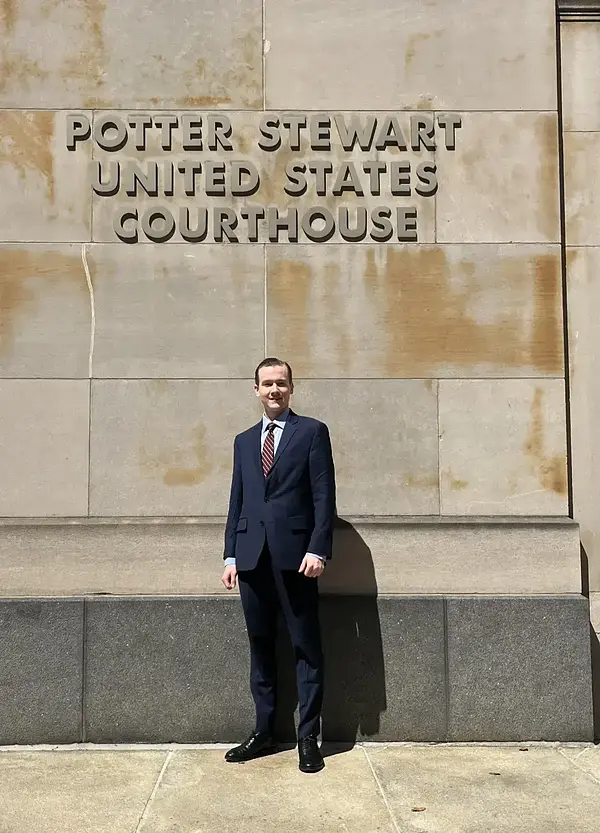
Bizily poses in front of the Potter Stewart United States Courthouse.
Kevin Bizily
Hailing from Minneapolis, Minnesota, Kevin Bizily is a rising junior in Stanford Hall. He is earning a major in the Program of Liberal Studies (PLS) and minors in Constitutional Studies, the Glynn Honors Program, and History. He also hopes to complete a supplemental major in Classics. At the CCCG, Bizily is a Tocqueville Fellow and a Writing Fellow. He serves as President of Undergraduate Moot Court, a mock legislative body, and as Deputy Grand Knight with the Knights of Columbus. This fall, he is a Teaching Assistant for Rev. Bill Dailey, C.S.C.’s class: Jurisprudence and the U.S. Constitution.
After attending a CCCG luncheon with Judge Amul Thapar of the United States Court of Appeals for the Sixth Circuit, Bizily took to heart Judge Thapar’s advice “to take risks and pursue available opportunities, even if the odds don’t look good.” The very next day, he attended office hours with Judge Thapar and left with an internship position. His interest in litigation stemmed from a high school internship under Judge David Stras (United States Court of Appeals for the Eighth Circuit), which helped him discern a prospective career in appellate work.
Under Judge Thapar, Bizily participated in all aspects of the office, proofreading and editing as well drafting memos and preparing cases. He also assisted with Judge Thapar’s work on the committees of the Judicial Conference. During his time, Bizily was struck the most by “the importance of clerkships and mentorship from judges” for younger attorneys and legislators. In a career path marked by changes, moves, and unpredictable twists, relationship established itself as the most valuable lesson.
Using these experiences, Bizily plans to “clerk in the appeals courts–maybe even for the Supreme Court–before practicing as a litigator.” He looks forward to leading undergraduate moot court this year, planning share the skills he has gained with his team and his peers at Notre Dame.
Scarlett Powell ‘28
Scarlett Powell is a junior Biology major living in Flaherty Hall. Her interests lie specifically in mammalogy and zoology and how animals interact with the human world. In addition to participating in the Tocqueville Fellows program, Powell is a member of the Notre Dame Synchronized Skating Team and an Accessibility Leader Fellow. A dual citizen of the United States and Poland, Powell had the opportunity to travel to Grudziadz, Poland, this past summer to perform a legal case study with District Court Judge Anna Madeja.
Powell combined her interests in biology and law to “dissect really every single article” the Polish legal system has published regarding animal cruelty and all the animal law cases that form the current Polish legislation. Powell and Judge Madeja would sit together for hours to analyze patterns and discuss the reasons and unique aspects of each bit of legislation.
This process not only allowed Powell to unlock an entirely new vocabulary in the Polish language, but it also aided in her discernment of her future as a biologist or attorney. Before the case study, Powell had felt torn between the two careers, finding a calling in both. The summer work, made possible by the CCCG, gave her much needed clarity. As Ms. Powell returns to campus this fall, she hopes to apply the patterns and legislative language she learned during her internship in her future career in parasitics.
John Vranas
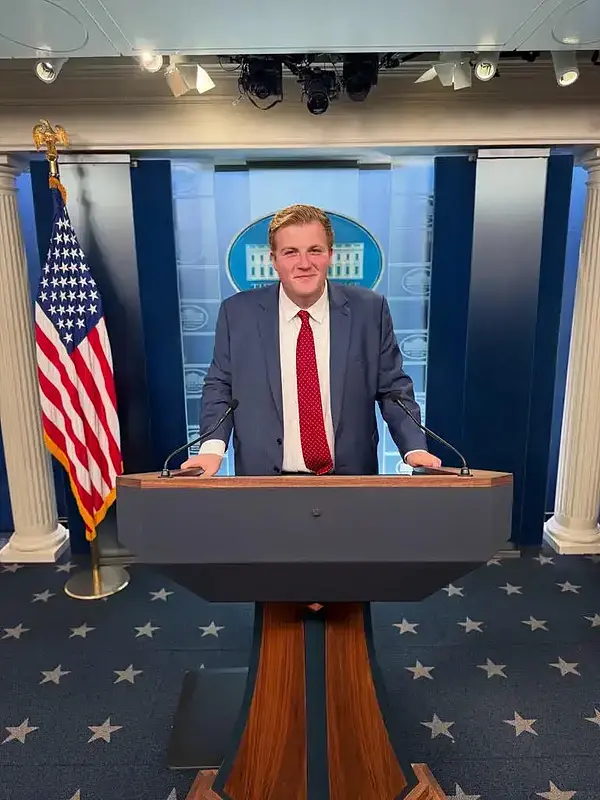
John Vranas, a rising senior from Lamont, Illinois, lives in Baumer Hall and is pursuing his degree in Political Science, minoring in Glynn Honors Program, Constitutional Studies, and Theology. He serves the ND community as President of the Notre Dame Mock Trial Team and President of the Notre Dame Orthodox Christian Fellowship. During his sophomore year, Vranas participated in the College of Arts and Letters Washington Program working under Senator Todd Young (IN). His time in DC, “so close to the action,” inspired Vranas to apply for the White House Internship Program.
Upon making it past several rigorous rounds of interviewing and background checks, Vranas began at the White House in the Office of Presidential Correspondence, with the financial backing of the CCCG. Within this office, he worked in the Agency Liaison Office, specifically assigning letters from the population to different committees and departments in order to ensure the citizens’ issues could be addressed adequately. After serving a while there, he was transferred to the Writers’ Division.
In this post, Vranas wrote to constituents ranging from war veterans to families struggling through tragedy on behalf of the President. The chance to “see the President’s words go to people and knowing that I was the one who drafted that up was an incredible honor.” Not only did this experience allow Vranas to establish close relationships with constituents, but he also seized the opportunity to get an “insider’s look” into how individuals in the Department of Justice and the White House end up in these specific careers. Vranas was especially grateful for the much more intimate Executive Branch office environment than Capitol Hill.
Vranas holds a “deep desire” to serve the public eventually in the Department of Justice. As Vranas comes back to Notre Dame, he’s excited to replicate the functionality he saw in the White House offices and to share his appreciation for all the work that occurs in DC that usually goes unnoticed by the public.
Originally published by Claire Glen at constudies.nd.edu on September 18, 2026.
]]>
Claire Glentag:politicalscience.nd.edu,2005:News/1856122026-09-17T14:44:00-04:002026-09-17T14:44:58-04:00Sierra’s New Book Explores How States Adapt Development Strategies to a Globalized Economy
Globalization did not end state-led development; it changed how governments pursue it. In a new book, Kellogg Faculty Fellow Jazmín Sierra shows how some developing countries have adapted industrial policy by supporting national firms beyond their borders.
Published in Cambridge University Press’s Cambridge Studies in Comparative Politics series, Globalized State-led Development: How States Support Firms at Home and Abroad (2026) draws on an in-depth study of Brazil alongside a comparative analysis of China. Sierra examines how governments support firms’ international expansion to gain access to foreign markets, knowledge, and technology—and, in turn, promote more productive and skill-intensive economic activity at home.
Sierra calls this model “globalized state-led development”: a system in which governments use financial institutions to shape firms’ domestic and foreign investments in pursuit of structural economic transformation.
The Kellogg Institute celebrated the book’s publication at a September 15 launch featuring Sierra, an assistant professor of political science at the University of Notre Dame, in conversation with Ben Ross Schneider of MIT and Dan Slater of the University of Michigan. The event was cosponsored by Notre Dame’s Department of Political Science.
Political Scientist Jazmín Sierra, Kellogg faculty fellow, at the launch of her newest book, Globalized State-led Development
“The central message of this book,” Sierra said, is that “late developers across the Global South have transformed their strategies for structural transformation, but they didn’t renounce the ambition for structural transformation.”
Both discussants described the book as agenda-setting, emphasizing how it places the internationalization of national firms at the center of the study of industrial policy. Schneider noted that although countries such as Brazil, China, and India have used firm internationalization as part of their development strategies, the phenomenon has received surprisingly little scholarly attention. The book, he said, “really stakes out this topic as an important agenda for research.”
Slater echoed that assessment. “It really brings internationalization into comparative politics in such an effective way,” he said. “I think it makes comparative politics bigger.”
At the heart of the book is a puzzle: globalization has narrowed some of the tools governments traditionally used for industrial policy, while democracy subjects state intervention to greater public scrutiny and political contestation. How, under those conditions, can governments continue to pursue ambitious strategies of economic transformation?
Sierra’s explanation centers on what she calls a “developmentalist legacy”: the survival of policymakers committed to structural transformation and state financial institutions capable of directing investment. Where that combination persists, she argues, governments can devise new ways of supporting national firms even as their economies become more open and globally integrated.
Rather than treating the market reforms of the late twentieth century as simply displacing earlier forms of state-led development, Sierra traces how developmental ideas and institutions persisted, changed, and were repurposed for a globalized economy. Schneider described the book’s analysis of ideas as a major theoretical contribution, emphasizing its reconstruction of how policymakers developed and debated new strategies of structural transformation.
Slater likewise praised the book for showing that the earlier era of developmentalism “still really matters” and that neoliberalism did not simply “wipe it out everywhere.”
The book also examines the effects of state support for firms’ foreign investments. Sierra shows how patient, risk-taking finance can enable firms to pursue investments they otherwise might avoid, while long-term relationships created through lending and equity investments give governments opportunities to influence business strategy. Her analysis finds that firms receiving state support gained greater access to foreign markets and knowledge through their overseas investments.
Schneider emphasized the book’s focus on firms as a distinctive contribution to the study of industrial policy. Scholarship, he noted, often focuses on governments, sectors, or policy instruments while paying less attention to the firms through which those policies operate. “All of the industrial policies in today’s capitalist world are going to have to run through private firms,” he said.
The book also examines the political conditions under which states can support firms’ global expansion. Such policies can generate tensions over jobs, public resources, environmental consequences, and the growing economic and political power of multinational companies. In Brazil, Sierra finds that unions, social movements, and other actors challenged aspects of BNDES policy and pushed the government to respond.
Rather than concluding that democratic contestation makes state-led development impossible, Sierra argues that it can also reshape and sometimes improve industrial policy. In Brazil, increasing scrutiny contributed to greater transparency, greater attention to social and environmental consequences, and a shift toward more market-oriented financial instruments.
“State-led development can operate under democracy,” Sierra said. “It’s going to be a fragile autonomy, but maybe that’s not such a bad thing.”
Schneider identified the relationship between democracy and industrial policy as another important contribution. “This book really … hits a nerve in contemporary discussions,” he said. “People really haven’t figured this out, about how to combine democracy and industrial policy.”
Dan Slater
Slater, for his part, emphasized the book’s comparative contribution, particularly its analysis of China. China pursued similar developmental goals under a dramatically different political system. Sierra said she was struck by the similarities in policy debates across Brazil and China, even as China’s political and financial institutions allowed state-backed internationalization to proceed on a much larger scale.
Schneider closed on a broader note of praise, calling Globalized State-led Development “a wonderful new book.” “The arguments convince, the story is compelling, the prose flows, the pieces all fit together,” he said.
The launch also marked the culmination of a project Sierra said had been shaped by the Kellogg community. The institute supported the book through research assistance, a book workshop, cover and editing expenses, and the launch event.
Sierra thanked Kellogg for providing not only “very strong financial support for this project,” but also “a really beautiful intellectual community that helped bring this project to fruition.”
Video from the September 15 book launch is available here.
]]>
Kellogg Institutetag:politicalscience.nd.edu,2005:News/1856072026-09-17T13:29:00-04:002026-09-17T13:55:52-04:00Mayra Ortiz Ocana, selected as a 2026 Emerging Scholar by the Harry Frank Guggenheim Foundation
HFG Welcomes Its 2026 Emerging Scholars
Mayra Ortiz Ocana
September 16, 2026
(NEW YORK) — Today, The Harry Frank Guggenheim Foundation announced the selection of its 2026 HFG Emerging Scholars. The nine doctoral candidates—selected through a rigorous evaluation process—are conducting research that increases understanding of problems of violence around the world.
The scholars are completing dissertations on a range of important topics, including school shooting incidents in the United States, anti-minority vigilante violence in India, and the governance of displaced populations and refugees in Lebanon and Turkey.
“Does cattle insurance reduce or increase violence between herders? What differentiates a school shooting that occurs from one that was prevented? What is it about psychopathic personality traits that elevates the risk of committing aggression and violence? How do prisons promote conflict between racial and ethnic groups? Each of our 2026 Emerging Scholars—all exceptional doctoral candidates—is asking a question whose answer will, we hope, help to reduce the misery caused by violence, as Harry Guggenheim intended in creating this foundation,” said HFG Director of Research Joel Wallman.
The awards are given to promising researchers in their final year of writing a doctoral dissertation that examines a salient aspect of violence. In selecting the awardees, HFG prioritizes research that addresses urgent, contemporary problems.
FIRST ROW: KARTHIKA BABY SUJATHA, JUDITH HOPPERMANN, LINDSAY J. LERNER, NAOMI NERO, ENRIQUE OLIVARES-PELAYO; SECOND ROW: MAYRA ORTIZ OCANA, EMMA RIKKEN, AARUSHI SHAH, YASH SHARMA
2026 Scholars and Research Topics
Karthika Baby Sujatha (United Nations University – Maastricht Economic and Social Research Institute on Innovation and Technology & Maastricht University)Understanding and Altering Men’s Attitudes, Tolerance, and Behaviors Towards Intimate Partner Violence: A Field Experiment in Kerala, India
Judith Hoppermann (SOAS, University of London)Governing Displacement, Contesting the State: Armed Transnational Movements, Refugees and Political Reordering in the Syrian Borderlands
Lindsay J. Lerner (John Jay College of Criminal Justice & The CUNY Graduate Center) Advancing School Safety: Comparing Completed & Averted School Shootings
Naomi Nero (Georgetown University)Valuing and Devaluing Others: Identifying Mechanisms Relevant to Predicting and Preventing Interpersonal Violence in Psychopathy
Enrique Olivares-Pelayo (University of Arizona)Running Raza: An Ethnography from Inside Arizona’s Prisons
Mayra Ortiz Ocana (University of Notre Dame) Gatekeeping Justice: Criminal Epistemologies in Prosecuting Organized Crime Violence
Emma Rikken (Wageningen University & Research) Drought, Rain, and Raiders: Testing Insurance and Edutainment Against Conflict in Africa
Aarushi Shah (Columbia University)Crime and Replenishment? An Ethnographic Study of the Remedial Work of a Domestic Violence Court in New York
Yash Sharma (University of Cincinnati)Majoritarianism and its Discontents: Violence, Mobilization and Resistance in Contemporary India
The Harry Frank Guggenheim Foundation is a leader in creating and disseminating knowledge on the nature, consequences, and reduction of violence in its many forms, including war, crime, and human aggression.
For more information contact:
Halima Gikandi, Senior Communications Manager
info@hfg.org | 646.428.0973
Originally published at HFG.org on September 16, 2026.
]]>
Halima Gikandi, Senior Communications Manager (info@hfg.org)tag:politicalscience.nd.edu,2005:News/1855512026-09-16T10:37:00-04:002026-09-16T10:37:10-04:00CCCG hosts rare artifact display for the publicDr. Stelluto introduces undergraduate students to the Remnant Trust documents.
The Center for Citizenship & Constitutional Government has partnered with the Remnant Trust to bring original, historical documents and artifacts to the University of Notre Dame. Fifteen documents and one artifact will be on display in the CCCG’s office on the fifth floor of Flanner Hall until October 12, 2026. The items are available by appointment to look at and even to handle.
The Remnant Trust is a Public Educational Foundation that provides first edition documents, manuscripts, annotations, and artifacts dating back to 2500 BC to the public with the goal of allowing each person to physically interact with the objects. Dr. Don Stelluto, Co-Director of the CCCG and the organizer of this exhibit, wants the students and broader community to enjoy every aspect this opportunity has to offer. History is not just ideas or written words, but rather is a “personal story that we uncover.” Physically interacting with these artifacts reminds individuals of the history of each object and of all those who may have interacted with it previously.
Below is a list of the manuscripts and artifacts currently on display in Flanner Hall:
Aquinas, Thomas, Summa Theologiae Pars SecundaSecunda Pars (1475)
Augustine of Hippo, Citie of God (Illuminated & Rubricated, 1494)
Magna Carta, The Great Charter Called in Latyn Magna Carta, with Diuers Olde Statues Whose Titles Appere in the Next Leafe Newly Corrected. Cum priuilegio ad imprimendum solum. (1542)
Trenchard, John and Thomas Gordon, Cato's Letters: or, Essays on Liberty, Civil, and Religious, and Other Important Subjects (1733-1754)
Locke, John, Two Treatises of Government (1st edition, 1764)
Paine, Thomas, Common Sense (1st British edition, 1776)
Paine, Thomas, Plain Truth (1st British edition, 1776)
Constitution of the United States of America, The Columbian Magazine (1st edition, 1787)
United States, The Gentleman's Magazine [Containing the First British Printing of the U.S. Constitution] (1787)
Adams, John, A Defence of the Constitutions of Government of the United States of America (1st edition, 1787-1788)
Hamilton, Alexander; James Madison; and John Jay, The Federalist: A Collection of Essays, Written in Favour of the New Constitution, as Agreed upon by the Federal Convention, September 17, 1787. Vol. II. (1st edition, 1788)
Jefferson, Thomas, A Manual of Parliamentary Practice. For the Use of the Senate of the United States. (1st edition, 1801)
U.S. Government, The Trial of the Alleged Assassins and Conspirators at Washington City, D.C., May and June, 1865. (1st edition, 1865).
Students examine the Remnant Trust artifacts.
When Dr. Stelluto was curating the exhibit, he “wanted to cover the range of what our students were interested in…what would really engage students in class.” Being able to physically interact with readings and lessons discussed in class “adds another level” to the human experience and “how ideas transcend time.” These items and their ideas prove the durability of the written word, and today all of Notre Dame can come and see and touch the physical renderings of those ideas with their own hands.
Until October 12, these documents are available for viewing on Thursdays from 3:00 - 5:00 p.m. ET, Fridays from 10:00 a.m. - 12:00 p.m. and 3:00 - 5:00 p.m., and by appointment. Contact Dr. Stelluto at Donald.Stelluto.1@nd.edu.
Originally published by Claire Glen at constudies.nd.edu on September 16, 2026.
]]>
Claire Glentag:politicalscience.nd.edu,2005:News/1855062026-09-14T15:59:00-04:002026-09-14T15:59:41-04:00Student Grant Recipients Finish Policy and Public Interest Internships
This summer, four students affiliated with the Center for Citizenship & Constitutional Government interned in public policy roles at think tanks and public interest law firms. Constitutional Studies minors Zachari Taylor ‘27 and Kerry Jiang ‘28 and Notre Dame Law School students Stephanie Luiz JD ‘28 and Chloe Garner JD ‘28 all received grants from the CCCG to make their internships possible.
Taylor worked at Novel Strategies, a public affairs firm in Washington, D.C. “I wanted to round out my policy experience,” he said, “by seeing how the private sector intersects with our government, and was fortunate enough to have a Notre Dame graduate put me in touch with the people at Novel Strategies.”
In his role, Taylor worked on legislative affairs, attending Congressional hearings, drafting policy briefs, and monitoring the progress of various bills. “As an intern, the team at Novel gave me responsibilities that made my work feel valued and important. I now have a deeper understanding of how our government operates and is influenced by outside actors, and the work that goes into effective outreach and policy messaging.”
Jiang poses with his team in front of the House of Representatives.
Jiang also worked in Washington, D.C. as an intern for the Religious Freedom Institute. At the Institute, Jiang principally worked on a report covering religious persecution under ISIS in Iraq. “I learned about the suffering these communities endured and explored how the United States can help protect them through law and public policy,” he said.
Throughout the summer, Jiang attended the Institute’s Statesman and Religious Freedom Seminar, studied religious freedom laws, and participated in weekly sessions exploring the connection between religious liberty and human dignity. Jiang finished the internship with a deeper understanding of the challenges for religious liberty: “Although religious freedom appears to be legally protected, growing secularism and hostility toward religion compel many people to hide their faith.” Consequently, he came away from this experience with a stronger grasp of its importance. “These concepts are especially relevant to me as a faithful Catholic because Dignitatis Humanae emphasizes that religious freedom is a fundamental right rooted in human dignity and that individuals should be free to seek religious truth.”
Luiz also worked on religious liberty issues in two different roles this summer, interning remotely for Napa Legal Institute in Boston, MA, and serving as a research assistant for Paul J. Schierl Professor of Law Rick Garnett at the Notre Dame Law School.
At Napa Legal, Luiz assisted with legal research and projects covering the separation of church and state, especially as it relates to religious charities and other organizations. “The experience allowed me to strengthen my legal research and writing skills while contributing to work that addresses important and developing religious-liberty issues.”
Garner poses in front of the Ohio Justice and Policy Center.
Luiz worked on similar projects for Professor Garnett, whose Freedom of Religion class she recently took. “I greatly enjoyed the class and hoped to serve as his research assistant so that I could help produce meaningful scholarly work in an area of law that I find especially important.”
In retrospect, Luiz looks forward to applying her academic work to help religious communities practice their faith. “I have appreciated the opportunity to see how careful legal scholarship can inform both academic discussion and the practical work of organizations serving religious communities.”
Garner worked in Cincinnati, OH at the Ohio Justice and Policy Center’s Human Rights in Prison project. “This summer, I examined hundreds of pages of medical records, familiarized myself with way too many cases of human rights violations in prison, and discovered the never-ending demand for the type of work OJPC is committed to.”
Garner explained how the internship shaped her perspectives on criminal justice. “This experience has taught me about the value each person has…. and the importance of recognizing the humanity of our clients, especially in the language we use.”
Returning to Notre Dame for the fall, Taylor, Jiang, Luiz, and Garner look forward to building on their internships and continuing to explore careers in public service.
Originally published by Kevin Bizily at constudies.nd.edu on September 14, 2026.
]]>
Kevin Bizilytag:politicalscience.nd.edu,2005:News/1853302026-09-07T13:40:00-04:002026-09-07T13:41:00-04:00Arts & Letters alumnae part of Pulitzer Prize-winning team for their coverage with the <em>Chicago Tribune</em>
Operation Midway Blitz was getting underway. Hundreds of U.S. Immigration and Customs Enforcement (ICE) agents were being deployed in the Chicago region, apprehending thousands of people.
Adriana Pérez ’22 was working her Sunday breaking news shift.
The Chicago Tribune reporter normally writes about the environment and climate change, but as one of the newspaper’s native Spanish speakers, she was sent to find and interview witnesses of one of the first arrests: a flower vendor who was picked off the street on Sept. 7, 2025, and deported to Mexico a few days later.
For the next two months, more arrests were made, and more stories needed to be told. Pérez paused much of her environment writing to continue interviewing and writing about Spanish-speaking ICE detainees and their families.
And she wasn’t working alone — far from it. The Chicago Tribune’s staff of more than 70 reporters, editors, and photojournalists — plus journalists at other publications throughout the city — dug deep into the stories coming to light in their community, ranging from safety risks of ICE tactics to Dr. Phil’s involvement in the immigration raids.
“Everyone feels so connected to Chicago and really wants to do right by Chicago, and I think all of that came through in the reporting.” - Madeline Buckley ’11, Chicago Tribune reporter
As a criminal justice reporter, Buckley covered legal issues around immigration arrests, among other topics. She debunked misinformation about protesters and detainees and, for one article, she and two other journalists investigated the Trump administration’s claims about violence perpetrated by protesters against immigration agents. Along with her colleagues, she analyzed court records and attempted to reach about 100 protesters. The resulting story revealed that many of the administration’s claims were untrue, and numerous cases weren’t holding up in court.
“It was an all-hands-on-deck situation,” Pérez said.
The Pulitzer Prize Board recognized the extraordinary efforts of the entire Chicago Tribune staff and awarded the newsroom the 2026 Pulitzer Prize in the Local Reporting category for their “powerful coverage.” They were also a finalist in the Public Service category.
At 1 p.m. on Friday, Nov. 20, Pérez and Buckley will have a conversation with fellow alumnus, journalist, and Pulitzer-winner Carlos Lozada ’93 in the Sojourner Truth Commons on the third floor of O’Shaughnessy Hall. They’ll discuss the politics of immigration reporting, the state of local news, and the Pulitzer Prize.
“Everyone at the Tribune was so dedicated and committed to telling the story,” Buckley said. “Everyone feels so connected to Chicago and really wants to do right by Chicago, and I think all of that came through in the reporting.”
From curiosity to climate change coverage
Though coming from a family of journalists, Pérez didn’t attend Notre Dame with plans to follow in their footsteps. She initially majored in psychology, and when she heard about the JED program, she applied more out of curiosity than ambition.
Adriana Pérez ’22 (Photo by Eileen Meslar)
But journalism must be genetic — Pérez loved it instantly.
The JED minor felt different from other classes — instead of MLA-formatted essays and reading textbooks, Pérez wrote magazine articles and studied the front page of The New York Times.
“It felt like I was learning about the world as things were happening,” she said.
Pérez quickly realized she wanted to switch her major to political science to better complement her new aspirations. The major helped her learn more about the people and systems she hoped to report on while giving her the flexibility to take classes related to her specific interests.
One writing seminar, The Politics of Borders, still influences the way Pérez approaches immigration. A main focus of the class was the importance of language when talking and writing about immigrants. Pérez learned that using terms like “masses” or “a wave” when describing immigrants can diminish individuality and dehumanize a vulnerable population. The class also discussed the moral implications of journalistic voyeurism — when a reporter infiltrates a community and uses their experiences for a story without contributing anything in return.
“Reporting is not just about grabbing their story and putting it on the page and never hearing from them again,” Pérez said. “You are there, in a way, to tell their story to their benefit.”
Pérez’s desire to help the communities she covers has always been central to her journalism career and has guided her toward environmental reporting.
She began at the Tribune as a breaking news intern, a role she secured through the JED program, and was hired full-time soon after. Within a year, Pérez’s editor asked what she wanted to do in the long term.
“Asking thoughtful questions, being curious — it’s a muscle you work on, and I wouldn’t have the basis for it if it wasn’t for my liberal arts education at Notre Dame.” - Adriana Pérez ’22, Chicago Tribune reporter
Her answer was something that’s easier said than done: fighting climate change.
“It’s the crisis of my generation,” she said. “And I realized I can address this problem from my place, from my talents and my passion.”
Pérez is originally from Ecuador, where many of the climate crisis’s most prominent stories take place: deforestation in the Amazon rainforest, plastic pollution in the Pacific Ocean, and overfishing in the Galapagos Islands. When people talk about climate change, she said, these are the landscapes and the problems that first come to mind.
When it comes to climate coverage, she admits the Midwest doesn’t get as much of the spotlight — not because its ecosystems are less important or less in danger. The Great Lakes, wetlands, and prairies have their own roles and needs, she said, so Chicagoans don’t need to look far to find nature they can protect.
“My job is saying, ‘There are things around you that you should care about,’” Pérez said. “And that’s very meaningful to me.”
She’s now been writing about the environment for three years, covering issues like intensifying heat waves, wildlife conservation, and the potential impacts of data centers. Through her work, Pérez serves the public while satisfying the curiosity that drew her to journalism in the first place.
“Asking thoughtful questions, being curious — it’s a muscle you work on, and I wouldn’t have the basis for it if it wasn’t for my liberal arts education at Notre Dame,” she said.
Think critically to make a better world
Before she was a Pulitzer Prize-winning journalist, Buckley was just a Notre Dame first-year student trying to get involved on campus.
Madeline Buckley ’11
She found her way to The Observer, a student newspaper serving the Notre Dame, Saint Mary’s College, and Holy Cross College campuses. Buckley wrote news stories and designed pages for the print paper while making lifelong friends, learning about her new home, and sparking her interest in journalism.
“It pretty much just immediately sucked me in,” she said.
Applying for the JED minor was the natural next step, and picking her major became a search for the best supplement to a journalism education. Buckley found American studies, which examines many important topics in American life and history. She said it was perfect preparation for a profession that requires knowledge about a little bit of everything.
During her four years, Buckley remained active at The Observer, eventually becoming a news editor and then managing editor.
“That was great training for being a journalist because you learn how to mine every aspect of your life for potential story ideas,” she said.
She gained off-campus experience through three journalism internships — at the South Bend Tribune, the Concord Monitor in New Hampshire, and the Pittsburgh Post-Gazette in Pennsylvania — with help from JED connections. By the time she got her diploma, Buckley was more than ready to become a full-time reporter.
She started out at the Brownsville Herald in small-town Texas, and then made her way to larger cities with bigger papers — back to the South Bend Tribune, then to The Indianapolis Star.
“I’m still learning new things every day, but those Arts & Letters classes teach you to think critically, which is an essential skill for journalists.” - Madline Buckley ’11, Chicago Tribune reporter
But Buckley grew up in Chicago’s suburbs, so working at the Chicago Tribune was always her dream. When the paper had an opening, she jumped at the opportunity.
“It’s a good feeling to have an impact in the place where you’re from,” she said.
Now Buckley has been with the Tribune for the last nine years, and while there’s definitely some childhood familiarity, her work has introduced her to new parts of the city. As a crime and courts reporter, Buckley digs into Cook County’s criminal justice policies and covers major trials that shape Chicago life.
For Buckley, reporting is more than sharing legal details and statistics, and more than telling individual stories — it’s writing the first draft of history, putting events into context. It requires the ability to analyze, which Buckley credits to her college days.
“I’m still learning new things every day, but those Arts & Letters classes teach you to think critically, which is an essential skill for journalists,” she said. “We have to evaluate our information for accuracy and for fairness and to make sure it merits publishing.”
It’s a significant undertaking, especially in one of the biggest cities in the country, but Buckley said she can’t imagine doing anything else.
“A lot of journalists will say, ‘We’re not doing it for the awards,’ and it’s a cliche, but I do think it’s true,” Buckley said. “Our main mission is to make the city a better place, and that is what will guide us going forward.”
Originally published by Adah McMillan at al.nd.edu on September 07, 2026.
]]>
Adah McMillantag:politicalscience.nd.edu,2005:News/1852412026-09-02T10:01:02-04:002026-09-02T10:01:02-04:00Remembering Peter R. Moody, Jr. by Letian Lei
My acquaintance with Professor Peter R. Moody, Jr. (1943-2026) began when I submitted a draft of my modest work on contemporary Chinese conservatism for his review. I was not only seeking the counsel of an American scholar profoundly versed in Chinese political thought but also paying homage to his pioneering research on the subject. Since that time, despite the Atlantic Ocean separating us, we maintained a frequent correspondence. Our discussions were exhaustive, ranging from the universal convergence of Western traditions and Chinese classics to the impact of the current Trump administration on American higher education, and from the Brezhnevian “era of stagnation” to the shifting tides of Chinese politics under Xi.
Moody’s focus was not limited to Chinese politics; he was also a dedicated student of Chinese culture. Whether discussing Han Feizi or the “Criticize Lin, Criticize Confucius” campaign, he spoke with effortless command; his intellectual reach extended across the breadth of the Confucian classics, history, philosophy, and literature. The line of Li Bai he often quoted as his personal motto – “Such is the pleasure of life in the world, as all things since antiquity have flowed away like the eastward-running water” – left an indelible impression on me.
This “Renaissance man” quality which is a rarity among American political scientists specializing in China was perhaps a heritage from his distinguished family. His father, Peter R. Moody, Sr., was a man of both action and intellect: after serving with distinction in the military during World War II, he traded his uniform for academia, earning a PhD in English from Cambridge and serving as a professor at the United States Air Force Academy.
Peter R. Moody, Jr. was born in San Francisco the year before his father deployed to the front. Whether his interest in China was sparked by childhood encounters with local Chinese communities or by the shared spirit of resistance against fascism during the war remains a mystery. When I asked if he had ever given interviews or written a memoir, Moody simply replied with characteristic understatement: he believed he might have contributed a few worthwhile academic insights, but he considered his own life’s journey unremarkable and not worth recording.
Indeed, the life of the younger Moody lacked the grand, turbulent scale of the elder’s. He attended the U.S. Air Force Academy High School, received his bachelor’s degree from Vanderbilt, and later earned his master’s and doctoral degrees from Yale. Shortly after graduation, he began his teaching career at Notre Dame, serving as assistant professor, associate professor, and professor until his retirement. Having lived in South Bend, Indiana, for over half a century, it is there that he will now rest in peace. Moody spent his life within the ivory tower, with little engagement in the media. Yet from his quiet existence in this Midwestern university town, he poured his lifelong care and intellectual fervor into the ebb and flow of events on the other side of the Pacific – into the shifting winds and clouds of a land thousands of miles away.
Moody was an outlier among Western sinologists of his generation, having been spared the trajectory from fervor to disillusionment with Maoism. Much like the idealistic Chinese youth of the 1930s and 1940s who looked toward the “clear skies” of the Yan’an “liberated zones,” many young Western leftists – who would later become prominent sinologists – traveled to Beijing during the Cultural Revolution, the “center of world revolution,” to witness this imagined utopia firsthand. The young Moody chose to pursue advanced studies in Taipei, likely unfettered by such romanticism and possessing the sobriety to weigh the lesser of two evils between “feudal fascism” and authoritarian capitalism.
In 1971, Moody defended his doctoral dissertation. His advisor was David N. Rowe, a sinologist then known for his “anti-communist” and “conservative” stance. Moody’s dissertation was concerned solely with the pragmatic games of interest groups. He argued that the failure of the Chinese Communist Party to achieve institutionalization between 1956 and 1969 stemmed from the fact that those political factions attempting to establish rules were unable to outlast those who secured power by breaking them.[1] This work served as the foundation for his subsequent publications, including Opposition and Dissent in Contemporary China (1977)[2] and Chinese Politics after Mao: Development and Liberalization (1983).[3]
With the passing of the strongman era, political democratization began to emerge on both sides of the Taiwan Strait. The political reforms in mainland China and the lifting of martial law in Taiwan during the mid-to-late 1980s were particularly striking. Moody’s focus shifted toward democratic transition, an intellectual interest reflected in his works Political Opposition in Post-Confucian Society (1988),[4]Political Change on Taiwan: A Study of Ruling Party Adaptability (1992),[5] and Tradition and Modernization in China and Japan (1995).[6]
Moody’s approach to studying the politics of China and East Asia generally adhered to the “modernization theory” paradigm. He maintained a view of gradual evolution, positing that change is typically the result of the interplay and compromise between tradition and modernity, and between government and opposition. Consequently, throughout the waves of democratization that swept across Eurasia, Moody remained steadfastly concerned with the legacy of “Confucian society,” the adaptive resilience of the “ruling party,” and the interaction between “tradition” and modernity. In contrast, the “revolutionary” paradigm – which once captivated North American academia – tended to interpret social history as a process of rupture, holding a deep-seated skepticism toward existing order.[7]
Viewed through the revolutionary lens, the transformation from a “semi-colonial, semi-feudal society” to democratic capitalism seemed achievable in a single stroke, while the key to “leaping into communism” lay solely in “the audacity of one’s conviction.” Prior to 1949, “revolutionary” sinologists largely viewed the revolution with sympathetic understanding, particularly regarding China’s liberal intellectuals; after 1949, however, they discovered that the reality of the post-revolutionary society did not align with their pre-revolutionary ideals. Those who insisted on the normative position of revolution found themselves calling for the next revolution – much like the writings of Arif Dirlik[8] – while others turned to acknowledge the explanatory power of modernization theory, as seen in John King Fairbank’s final work, China: A New History (1992).[9]
While the modernization and revolutionary paradigms differ in their paths – reform versus revolution, realism versus utopianism, elitism versus populism – both subscribe to historical progressivism. Both share the belief that China and its people should not, and will not, be absent from the common human enterprise of Enlightenment and liberation: from scarcity to abundance, from tyranny to democracy, from dependency to independence, from brutality to humanity, and from superstition to secularism. Moody remained, to the end, a guardian of common sense and reason.
Moody’s final monograph, Conservative Thought in Contemporary China (2007),[10] stands as the magnum opus of his scholarly career. His earlier works had established his reputation as a renowned scholar of Chinese politics, but this book solidified his stature as a profound political theorist. Most American scholars of Chinese politics specialize in comparative politics or international relations, focusing on domestic affairs or foreign policy, and rarely venture into political theory. Yet the genuine questions within Chinese politics and the profound inquiries of political science must always be explored from the heights of theory and thought.
In recent decades, political theorists have sought to integrate non-Western thought into the discipline, fostering a budding scholarly trend known as “comparative political theory.” Moody’s tireless contributions to The Review of Politics – where he long served as book review editor – will be remembered as an enduring, pioneering contribution to that field.
Two months before his death, he closed his last letter to me with the words: “I hope we can keep in touch…” At the time, I did not grasp the weight behind those ellipses. Reading them now, I feel as though I have been struck a heavy blow to the chest. Though I am an agnostic, I find myself praying for the soul of this devout Catholic, that he may find salvation and enjoy eternal peace and joy in the Kingdom of Heaven.
Letian Lei works on modern China, intellectual history, and political theory. Having studied in Prague, Edinburgh, Vienna, Geneva, and Bloomington, Indiana, he is currently pursuing a PhD at Cornell University. His dissertation is tentatively titled "The Chinese Ideology: Liberalism, Conservatism, and the Left, 1978-2021." His articles have appeared in Journal of Political Ideologies, The China Quarterly, Waiguo Zhexue, and Sixiang.
[1] Moody, Peter R. The Politics of the Eighth Central Committee of the Communist Party of China. Hamden, Conn.: Shoe String Press, 1973.
[2] Moody, Peter R. Opposition and Dissent in Contemporary China. Stanford, Calif.: Hoover Institution Press, 1977.
[3] Moody, Peter R. Chinese Politics after Mao: Development and Liberalization, 1976 to 1983. New York, N.Y.: Praeger, 1983.
[4] Moody, Peter R. Political Opposition in Post-Confucian Society. New York, N.Y.: Praeger, 1988.
[5] Moody, Peter R. Political Change on Taiwan: A Study of Ruling Party Adaptability. New York, N.Y.: Praeger, 1992.
[6] Moody, Peter R. Tradition and Modernization in China and Japan. Belmont, Calif.: Wadsworth, 1995.
[7] Myers, Ramon H., and Thomas A. Metzger. “Sinological Shadows: The State of Modern China Studies in the United States.” The Washington Quarterly 3, no. 2 (1980): 87-114.
[8] Dirlik, Arif. “June Fourth at 25: Forget Tiananmen, You Don’t Want to Hurt the Chinese People’s Feelings – and Miss Out on the Business of the New ‘New China’!” International Journal of China Studies 5, no. 2 (2014): 295-329.
[9] Fairbank, John King. China: A New History. Cambridge, Mass.: Havard University Press, 1992.
[10] Moody, Peter R. Conservative Thought in Contemporary China. Lexington Books, 2007.
]]>
Kelli Browntag:politicalscience.nd.edu,2005:News/1851512026-08-31T07:50:00-04:002026-08-31T07:50:08-04:00Center for Citizenship and Constitutional Government to mark 25th anniversary of 9/11 with panel sharing personal experiences, reflecting on legacy
The University of Notre Dame’s Center for Citizenship and Constitutional Government will commemorate the 25th anniversary of September 11, 2001, with a special edition of its annual Jeanie Poole O’Shaughnessy Memorial Lecture at 3:30 p.m. on Friday, Sept. 11 in the Leighton Concert Hall at the DeBartolo Performing Arts Center.
“25 Years After 9/11” will bring together four distinguished members of the Notre Dame community and beyond to reflect on their personal experiences of September 11 and the lasting significance of that day for American civic life: U.S. Supreme Court Justice Brett M. Kavanaugh; Rev. Edward A. “Monk” Malloy, C.S.C., president emeritus of the University of Notre Dame; Jennie Bradley Lichter, Notre Dame alumna and senior advisor to the March for Life Education and Defense Fund; and James J. “Jimmy” Dunne III, Notre Dame trustee and vice chairman and senior managing principal of Piper Sandler. The conversation will be moderated by Vincent Phillip Muñoz, director of the Center for Citizenship and Constitutional Government.
The conversation will offer an opportunity not only to remember the nearly 3,000 people who lost their lives, but also to consider what 9/11 means for America. Drawing on the panelists’ personal experiences of the day itself and their careers in law, higher education, public service and business, the conversation will explore how September 11 continues to shape our understandings of citizenship, solidarity, sacrifice, and leadership — and what those experiences might teach a new generation about the responsibilities of life in a constitutional democracy.
“Twenty-five years after September 11, we have an opportunity to remember the lives that were lost, recall the extraordinary acts of courage and selflessness that were displayed, and also to ask what 9/11 teaches us about our responsibilities to one another and to our country,” said Muñoz. “At the Center, we believe that remembering our history is essential to forming citizens capable of sustaining our constitutional order and pursuing the common good.”
Kavanaugh has served as an associate justice of the Supreme Court of the United States since 2018, following his nomination by President Donald J. Trump. On 9/11/2001, he was associate counsel in the White House of former President George W. Bush.
Father Malloy is a professor of theory and Christian ethics. On 9/11/2001, he was president of the University of Notre Dame.
Lichter, a 2004 Notre Dame graduate, is senior advisor to and former president of the March for Life Education and Defense Fund. On 9/11/2001, she was a sophomore at Notre Dame. She has served in senior legal, policy and public-sector roles, including as deputy assistant to the president and deputy director of the White House Domestic Policy Council during the first Trump administration.
Dunne is vice chairman and senior managing principal of Piper Sandler and a longtime leader in the financial services industry. A 1980 Notre Dame graduate, he served as the University’s 2021 Commencement speaker and received an honorary doctor of laws degree from Notre Dame.
The Jeanie Poole O’Shaughnessy Memorial Lecture was established in 2022 following the death of Jeanie Poole O’Shaughnessy, a beloved friend and supporter of the Center. It is and was made possible through the generosity of her husband, J. Patrick O’Shaughnessy, Jeanie’s friends, and the O’Shaughnessy family. The event aims to help Notre Dame students and the Notre Dame community connect scholarship and education concerning the ideas and institutions of constitutional government with the principles put into practice by the individuals shaping the civic fabric of our country.
Previous Jeanie Poole O’Shaughnessy Memorial Lecture speakers have included U.S. Sen. Tim Scott of South Carolina, former U.S. Secretary of State Michael Pompeo, Florida Gov. Ron DeSantis, and U.S. Supreme Court Justice Amy Coney Barrett. The lecture reflects the Center’s broader commitment to introducing Notre Dame students to prominent public figures and providing opportunities to consider the principles, virtues, and responsibilities that accompany civic leadership.
The Center for Citizenship and Constitutional Government seeks to cultivate thoughtful and educated citizens by supporting scholarship and education concerning the ideas and institutions of constitutional government. Through lectures, seminars, fellowships, and other programs, the Center seeks to prepare students to participate thoughtfully in civic life and contribute to the public good.
While tickets are no longer available through the Center’s website, a limited number of tickets will be available in a standby line at the DeBartolo Performing Arts Center the day of the event to students, faculty, and staff with a valid Notre Dame ID. If you have questions about how you may obtain a ticket, or for any other matter pertaining to “25 Years After 9/11,” please reach out to CCCG Assistant Director Anna Bradley at abradle4@nd.edu.
Originally published by Anna Bradley at constudies.nd.edu on August 28, 2026.
]]>
Anna Bradleytag:politicalscience.nd.edu,2005:News/1849422026-08-20T09:46:00-04:002026-08-20T09:46:26-04:00Constitutional studies graduate students explore French culture, political thought, and languageThompson, Arildsen, and Richards with the rest of the Academia Tocqueville participants.
Thompson, Arildsen, and Richards attended Academia Tocqueville, a 12-day intensive seminar in Paris examining the French political tradition. Founded in 2023 with the help of Luke Foster, an assistant professor of government at Hillsdale College and former CCCG postdoctoral fellow, Academia Tocqueville teaches students “to understand the answers French thinkers have offered to the most difficult questions of the modern era.” Outside the classroom, students explored Paris and experienced French culture through art, local cuisine, and even wine tasting.
For Thompson, Academia Tocqueville naturally filled a gap in his previous studies in political theory. In the United States, political theory traditionally concentrates on American and English thinkers. Thompson, however, was drawn in by Foster’s vision of an “immersive educational experience that seeks to remedy the unfortunate neglect of parts of the French intellectual tradition in American colleges.”
By the end of the program, Thompson’s expectations were exceeded.
“The two weeks we spent intensively surveying some of the highlights of French political thought since the Revolution were some of the most formative intellectual experiences of my life,” he said. “And will surely serve as the basis for future study and conversations back here at Notre Dame.”
Studying the French political tradition offered Richards, whose research focuses on American constitutionalism, a deeper understanding of the overlap between our own tradition and the French.
"One of the most impactful practices was studying French works that have been adopted into the American tradition of political thought, such as Montesquieu and Tocqueville, from the French perspective,” she said. “I walked away from the program with a better grasp, not only of French political thought but also with new questions about how we think about French works in the American tradition."
Arildsen attends the Academia Tocqueville seminar.
Though Arildsen came into the program with a basic understanding of the French political tradition, he said “Academia Tocqueville rapidly deepened and expanded that understanding.”
During his trip, Arildsen recalled learning a new, uniquely French way of thinking.
“The lectures were riveting, in part because they were a fresh — and distinctively French— perspective on familiar political themes, like immigration, religion, class, and republicanism," he said. "The peers in the cohort were also engaging, intellectually curious, and from a wide variety of backgrounds. I look forward to crossing paths with them in the future.”
Coddington pictured at the French Renaissance estate, Château de Chambord.
Coddington, who had previously attended Academia Tocqueville in 2024, participated in an intensive French language course through the Institut de Touraine. Founded in 1912, the Institut offers immersive language programs teaching what Coddington described as “the king’s French.” Given his dissertation research comparing constitutional theory between the United States and France, studying the language was a natural choice.
Beyond mastering the language, Coddington reflected on his experience with the local culture.
“I have met many friends through the local parish here who have been very kind and helpful as I practice my French," he said. "I have also had the opportunity to explore many of the local historical sites and chateaux, as the region is known for some of the best wine in France.”
Originally published by Kevin Bizily at constudies.nd.edu on July 30, 2026.