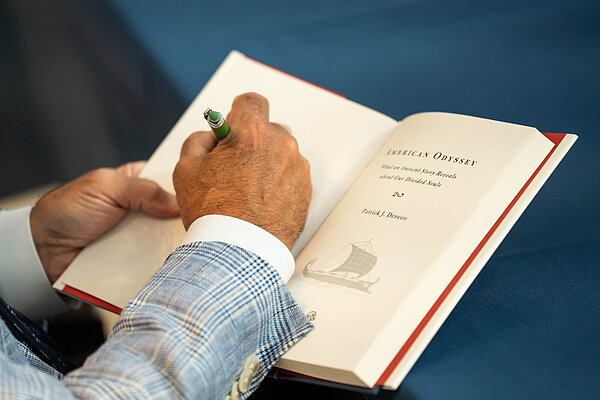
Well-known professor of political science Patrick Deneen gave a lecture on August 27 based on his newest book, American Odyssey: What an Ancient Story Reveals about Our Divided Souls. This lecture, hosted by the Center for Citizenship and Constitutional Government (CCCG), took place in the wake of the United States of America’s semiquincentennial and the theatrical release of Christopher Nolan’s adaption of the Odyssey.
Deneen, who previously taught at Princeton University and Georgetown University, rose to national prominence following the 2018 publication of his book, Why Liberalism Failed. He is also the author of Regime Change: Towards a Postliberal Future (2023). Notably, his 1995 award-winning dissertation is also based on the Odyssey, entitled The Odyssey of Political Theory: Homer's "Odyssey" as Political Theory and as Interpreted in the History of Political Thought.
Deneen began his lecture by asking a simple question: “What do the birth of America and the ancient epic of the Odyssey have to do with each other? … I dare say, a great deal.” Like Odysseus, America’s forerunners undertook an arduous journey by sea. Odysseus traveled to find his home; our pilgrims hoped to find theirs.
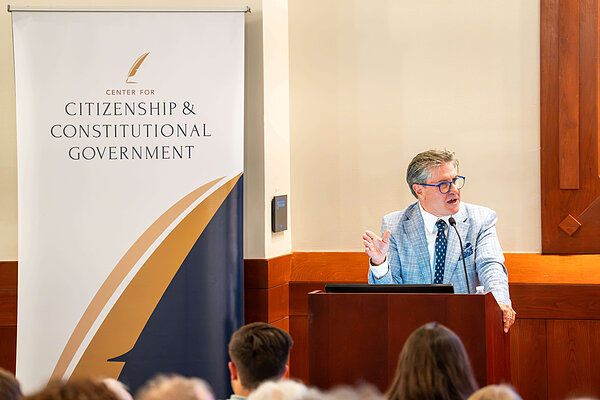
Referencing the Star Trek franchise, Deneen applied its most recognizable phrase to the American people, past and present: we have a “craving and desire ‘to explore strange new worlds; to seek out new life and new civilizations; to boldly go where no man has gone before.’”
He continued, “Even before we thought of ourselves as Americans, before the official birth of our nation, our forebears were embodiments of … one of the most deeply ingrained American characteristics: the desire to explore; the restless craving for more, for the distinct, for the new; the dissatisfaction of the familiar that would become the engine of our—even today—exploratory and entrepreneurial spirit.”
Dorothy Gale in The Wizard of Oz, Deneen said, exemplifies this American spirit. In Dorothy, “We encounter a version of ourselves, a young dreamer marked by that characteristic discontent … longing for that better place that lies beyond the horizons that just at this moment accidentally contain us.” And yet, by the end of the journey, her mantra is, “‘There's no place like home. There’s no place like home.’ … That will bring her home.”
Deneen used the example of George Bailey in It’s a Wonderful Life as another illustration. Bailey “desperately craves to get out of Bedford Falls,” yet “nevertheless becomes perhaps the greatest of contributors to the life of his town in a way that was unseen and unbeknownst, even to himself…” By committing to Bedford Falls and relinquishing personal ambition, he saves the whole community from ruin. During the Q&A, Deneen held Bailey out as a worthy model for students who are animated but also concerned by this American spirit. Odysseus, Deneen reminded students, was condemned by the poet Dante for his “lust to experience the far-flung world and the failings and felicities of mankind,” for which he left his family. He also recalled one of Tocqueville's observations of Americans: “Americans will build a house, and before the roof is finished, they'll sell it and look for another one.”
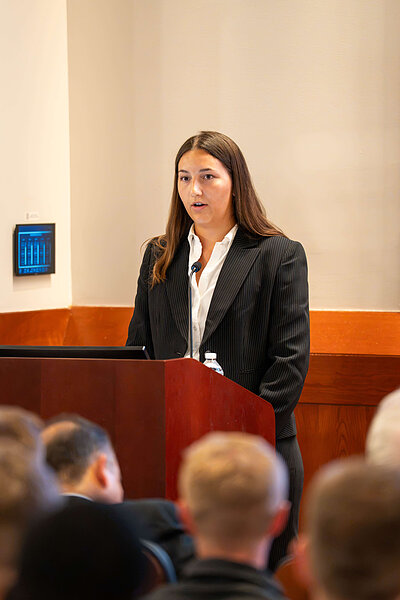
Yet, George Bailey offers a solution. By setting down roots and investing in their communities, students can be like the heroic—though unglamorous—George Bailey.
Mercedes Curran, a senior Tocqueville fellow, reflected on the lecture. “For the students in the audience, Deneen offered moving remarks about discerning what their service might be to their communities, in light of the prudential lessons pulled from the Odyssey.” Though Deneen “may have left listeners with more questions than answers, it encouraged us to consider the balances and nuances of what it means to be an American.”
Connor Morrissey, a graduate student in Notre Dame’s sacred music program, said, “One of the things that I found the most fascinating about this particular lecture is the personification of the Aristotelian quote that ‘virtue is the mean between two vices.’ We have to steer in between the American Scylla and the American Charybdis, and how we might have to chart our course closer or further from one or the other depends on where we're at in our civilizational zeitgeist.”
The students who attended the event departed with a choice: Should they be a homebody or a pioneer? A trailblazer or a family man? A possible answer includes both—so long as one can avoid the worst snares of either, one may embody what it truly means to be an American.
To view the full recording of Deneen’s remarks, as well as past event archives, visit our lecture library.
To stay up to date with additional CCCG programming, subscribe to our email list.
Originally published by at constudies.nd.edu on September 27, 2026.